

ADHD and Emotional Regulation: Why Your Feelings Can Feel So Much Bigger
ADHD can affect more than attention. For many adults, emotions can feel unusually intense, difficult to shift away from, or slow to recover from. Understanding emotional regulation can replace shame with a more useful question: What's happening in my brain, and what do I need?
You’re having a perfectly reasonable reaction.
At least, that’s what you tell yourself.
Then you realize you’ve been thinking about the email for three hours.
A small criticism ruins your entire afternoon.
You get disproportionately angry about something that seemed minor five minutes ago.
Or you’re so overwhelmed by everything happening at once that you need to shut down completely.
And afterward comes the familiar question:
Why am I like this?
If you have ADHD, you may have spent years assuming that your emotional reactions were a character flaw. Maybe you’ve been called dramatic, sensitive, intense, impulsive, or difficult. Maybe you’ve learned to hide strong emotions because you’re afraid of what other people will think.
But emotional regulation can be genuinely difficult with ADHD.
And understanding that doesn’t mean excusing every reaction. It means finally having a more accurate explanation for what’s happening.
ADHD Isn’t Just About Attention
One of the biggest misconceptions about ADHD is that it’s primarily a problem with attention.
But ADHD affects much more than whether you can concentrate during a meeting.
It can affect impulse control, working memory, motivation, transitions, planning, and your ability to shift your attention from one thing to another.
That includes shifting emotional attention.
When something upsetting happens, your brain may have a harder time disengaging from it.
You know you should stop replaying the conversation.
You know checking the news again won’t make you feel better.
You know the disagreement probably isn’t as catastrophic as it feels right now.
But knowing something intellectually doesn’t necessarily mean your brain can shift gears on command.
That’s one reason ADHD and emotional regulation can become so intertwined.
When a Small Thing Becomes a Very Big Thing
Emotional dysregulation isn’t an official diagnostic criterion for ADHD, but many adults with ADHD report significant difficulty managing the intensity, duration, or recovery time associated with emotions.
You might experience:
Frustration that escalates quickly
Strong reactions to criticism or perceived rejection
Difficulty letting go of upsetting thoughts
Emotional overwhelm when several stressors pile up
Impulsive responses during conflict
Irritability when you're hungry, tired, overstimulated, or overwhelmed
Feeling emotionally flooded and unable to think clearly
Needing much longer than expected to recover after something upsetting
None of this means your emotions aren't legitimate.
The problem is often what happens after the emotion arrives.
Your nervous system reacts.
Your attention locks onto the problem.
Your thoughts start spiraling.
And suddenly the original issue is joined by ten more problems your brain has found to worry about.
This can make an emotional response feel enormous, even when the original trigger was relatively small.
Rejection Can Hit Especially Hard
For many adults with ADHD, interpersonal situations can be particularly activating.
A delayed text.
A change in someone's tone.
A boss's brief criticism.
A friend canceling plans.
Someone seeming disappointed in you.
Your brain may immediately start filling in the blanks.
They're annoyed with me.
I screwed something up.
They're going to think I'm incompetent.
I should never have said that.
I knew they didn't really like me.
This is sometimes described as rejection sensitivity dysphoria (RSD), although that term isn't a formal ADHD diagnosis and is used inconsistently.
What's important clinically is the underlying experience: perceived rejection or criticism can trigger a disproportionately intense emotional response for some people with ADHD.
And if you've spent years being criticized for being late, disorganized, forgetful, emotional, or inconsistent, criticism may carry a lot of history with it.
You're not reacting only to today's comment.
You're reacting to everything that comment reminds you of.
Emotional Regulation Gets Harder When You're Already Exhausted
There's another piece that often gets missed.
Your emotional regulation skills don't exist separately from the rest of your life.
Sleep deprivation matters.
Chronic stress matters.
Sensory overload matters.
Hormonal changes can matter.
Work demands matter.
Relationship stress matters.
And constantly compensating for ADHD matters.
If you've spent the entire day remembering appointments, monitoring your facial expressions, double-checking your work, forcing yourself to stay focused, responding to messages you've been avoiding, and trying to appear completely fine while doing all of it, you may have very little bandwidth left by the time you get home.
That can look like:
"I held it together all day, and then completely lost it over the dishwasher."
The dishwasher isn't necessarily the problem.
It's just where the accumulated stress finally found somewhere to land.
You Don't Need to Become Less Emotional
This is an important distinction.
The goal of emotional regulation isn't to become calm all the time.
It isn't to stop caring.
It isn't to suppress anger, sadness, excitement, grief, or frustration.
And it definitely isn't to become the kind of person who can calmly tolerate anything without reacting.
Emotions contain information.
Anger can tell you something feels unfair.
Sadness can tell you something matters.
Anxiety can signal uncertainty or perceived threat.
Grief can tell you you've lost something important.
The goal is to create enough space between feeling and responding that you have choices.
You can be angry without sending the text.
You can feel rejected without immediately deciding the relationship is over.
You can be overwhelmed without deciding you're incapable.
You can be deeply affected by what's happening in the world without spending six hours doomscrolling yourself into exhaustion.
That space is where emotional regulation lives.
The Shame Often Comes After the Emotion
For many adults with ADHD, the hardest part isn't the original emotional reaction.
It's what comes afterward.
You replay what you said.
You criticize yourself.
You wonder if you were too much.
You apologize excessively.
You promise yourself you'll never react that way again.
And then you feel ashamed that you couldn't simply control yourself.
This creates another cycle:
Trigger → intense emotion → reaction → shame → self-criticism → more emotional vulnerability
Shame doesn't necessarily make emotional regulation easier.
Often, it makes it harder.
If your internal response to every difficult emotion is I shouldn't be feeling this, you're now dealing with both the original emotion and a second layer of judgment.
Learning to regulate emotions starts with noticing what's happening without immediately turning it into a verdict about who you are.
A Therapist's Perspective
One of the things I often want clients to understand is that emotional regulation isn't the same thing as emotional suppression.
We're not trying to make you less sensitive.
We're trying to help you understand your patterns well enough that you have more choices.
That might mean learning to recognize the early signs of overwhelm.
It might mean identifying situations where you're more vulnerable to emotional flooding.
It might mean creating a pause between an emotional reaction and an impulsive response.
It might mean working on the shame that has accumulated around years of being told you're "too much."
And sometimes it means looking at the bigger picture.
If you're constantly exhausted, overextended, masking, perfectionistic, or trying to compensate for ADHD without enough support, emotional regulation may be much harder than it needs to be.
Therapy can help you stop treating every emotional reaction as evidence that you've failed.
Instead, we can get curious.
What happened? What did your brain interpret? What did your nervous system do next? What did you need in that moment?
Those questions create much more room for change than What's wrong with me?
Emotional Regulation Is a Skill, Not a Personality Trait
You don't have to become a different person to become better at regulating your emotions.
You don't have to care less.
You don't have to become endlessly patient.
And you don't have to stop having big feelings.
You can learn to recognize what is happening earlier.
You can learn what makes emotional flooding more likely.
You can practice pausing before responding.
You can develop ways to recover more quickly.
And you can stop adding shame to an already difficult experience.
That's especially important for adults who have spent decades believing their emotions were just another thing they needed to "fix."
Conclusion
ADHD can affect more than your ability to pay attention.
It can affect how quickly emotions rise, how difficult they are to shift away from, and how long it takes to recover.
But having strong emotions doesn't mean you're immature, dramatic, irrational, or broken.
It means there's something worth understanding about how your brain and nervous system respond to stress, stimulation, rejection, and overwhelm.
You don't need to feel less. You need more room between what you feel and what you do next.
If you're an adult with ADHD who feels like your emotions are sometimes running the show, therapy can help you understand the patterns underneath them. We can work on emotional regulation without turning your sensitivity into another thing you need to be ashamed of.
If you'd like to explore ADHD therapy with me, you can learn more about working together through my practice.

Perfectionism: The Sneaky Symptom of ADHD You Didn’t See Coming
Perfectionism can be an unexpected coping strategy for adults with ADHD. If you’re constantly rewriting, overpreparing, or avoiding tasks unless you can do them perfectly, ADHD may be part of the story.
You rewrite the email five times before hitting send. You plan out a project but don’t start because the conditions aren’t “perfect.”If it can’t be done flawlessly, it might as well not be done at all.
Sound familiar?
Perfectionism is one of the sneakiest coping strategies for ADHD. And here’s why: when you’ve spent years feeling “behind,” criticized for being late or messy, you overcorrect. You try to be the most prepared, most polished, most precise - not to shine, but to avoid being seen as deficient.
But perfectionism is a trap. It creates unrealistic standards that keep you stuck. It turns progress into paralysis.
In therapy, we examine where this pattern started. Was it the teacher who gave you praise only when you got it right? The workplace that micromanaged your every move? The internal voice that says, “You’ll never be enough unless you do it perfectly”?
We learn to tolerate “good enough.” We separate your worth from your output. And we build the emotional resilience to mess up sometimes - without spiraling.
Because life with ADHD is messy. But that doesn’t mean it’s wrong.
You don’t have to be perfect to be worthy. Therapy can help you let go.
Time Blindness Is Real - You’re Not Just Bad at Being an Adult
You’re not careless, irresponsible, or bad at managing your life just because time seems to work differently for you. For adults with ADHD, time blindness can make everyday responsibilities surprisingly difficult - and surprisingly exhausting.
You swear you’re going to leave the house on time. You set alarms, give yourself a buffer, even lay out your keys and shoes. But somehow, 10 minutes turns into 45, and now you’re apologizing again - breathless, anxious, frustrated, ashamed.
This isn’t irresponsibility. This is time blindness, and it’s one of the most overlooked ADHD symptoms.
When you have ADHD, time doesn’t pass in a predictable or tangible way. You don’t experience minutes and hours the way others seem to. You live in two states: now and not now.
That means:
Deadlines sneak up even when you know they’re coming.
“It’ll just take five minutes” turns into an hour.
Starting a task feels impossible until the panic of last-minute urgency kicks in.
You miss appointments - not because you don’t care, but because time evaporated without warning.
You’ve probably internalized a lot of shame about this. People have called you careless or flaky. You’ve apologized over and over, sometimes even believing you’re just bad at being an adult.
But therapy helps you approach this with clarity, not criticism.
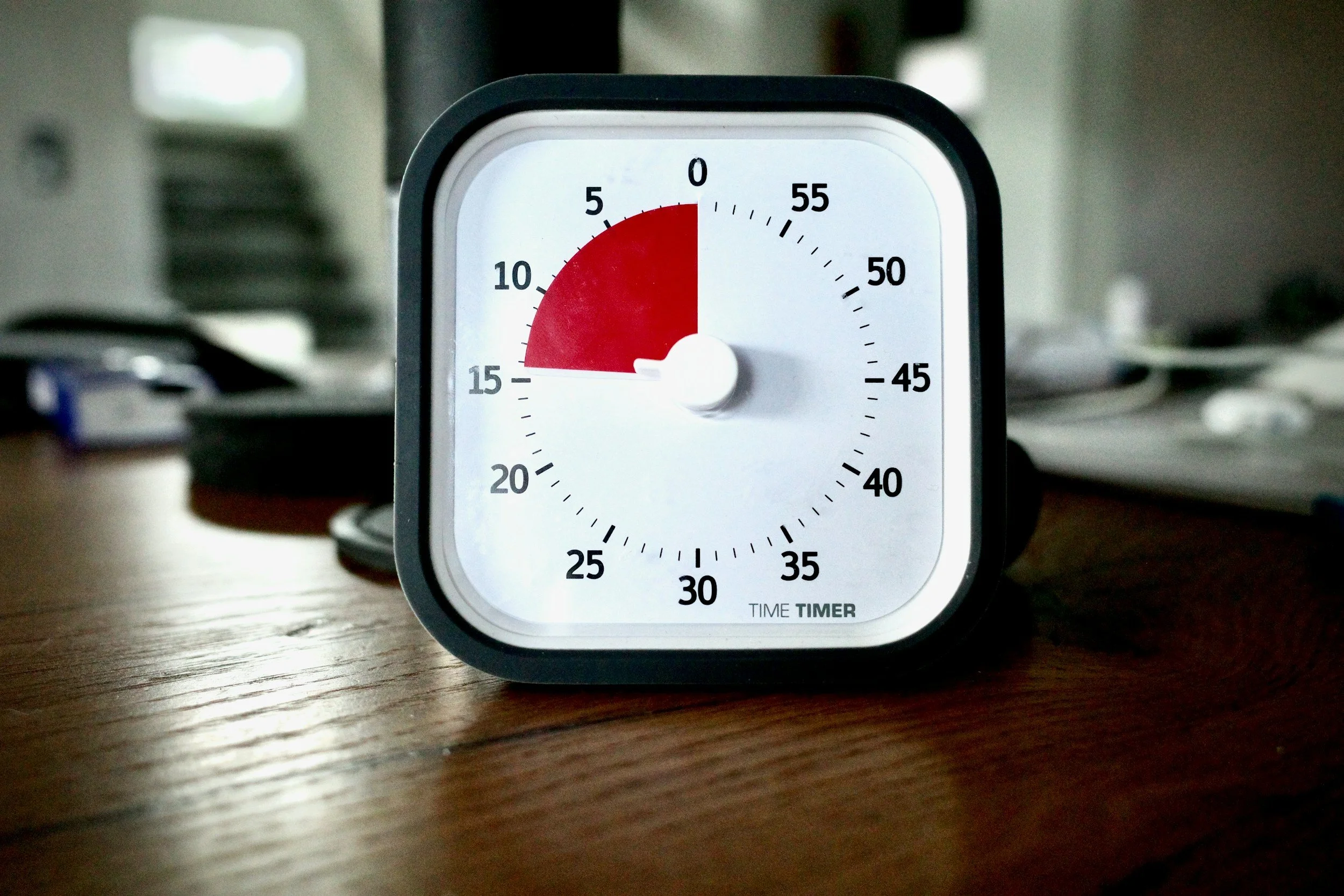
Together, we externalize time. That might mean using analog clocks, countdown timers, visual planners, or even “body-doubling” to stay anchored. We find what works for your brain - not what looks good on productivity TikTok.
We also unpack the emotional toll: the guilt, the hit to your self-esteem, the fear of being seen as unreliable. Because this isn’t just about getting places on time. It’s about reclaiming a sense of control and trust in yourself.
Time isn’t your enemy - and you’re not broken. Therapy can help you build tools that make time work with your brain.

You’re Not Lazy - You’re Just Wired Differently
You’re not unmotivated. You’re exhausted from trying to meet expectations that don’t account for how your brain works.
You told yourself you’d start the project at 9 a.m. You even set up your desk. Made coffee. But now it’s 3:42 p.m. and you haven’t touched it. Instead, you’ve been scrolling, pacing, and berating yourself.
“Why am I like this?”
It feels like laziness. Everyone else seems to be able to just start. So why can’t you?
Because this isn’t laziness. This is executive dysfunction.
Your brain has trouble initiating tasks, organizing steps, and regulating emotions when overwhelmed. And the more you shame yourself, the harder it gets to begin. Shame isn’t a motivator - it’s a shutdown switch.
You’re not unmotivated. You’re exhausted from trying to meet expectations that don’t account for how your brain works.
In therapy, we explore what’s actually getting in the way. We interrupt the self-blame. We build supports - reminders, routines, permissions - that work for you, not against you. We shift the story from "lazy" to "living in a system that never explained how your brain works."
If you’re done shaming yourself, I’m here to help you rebuild.